Multiflow
Particle laden flows
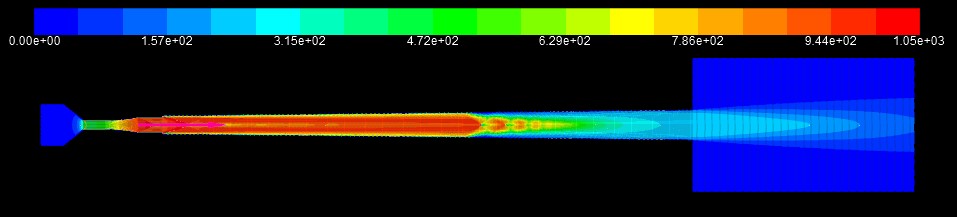
In particle-laden systems such as Cold Spray (CS), the operational efficiency of the process is strongly influenced by the in-flight characteristics of the particles. These characteristics are critical because they govern the impact-related surface phenomena that determine deposition quality. The complexity increases significantly for particles traveling within a supersonic flow, where inertial, rarefaction, and compressibility effects must all be accounted for. Computational fluid dynamics (CFD) models are commonly used to predict the coupling between the carrier gas flow and the particles entrained within it. Compressibility effects can generate shock patterns around particles—even at micrometer scales—which significantly alter their motion and temperature. To analyze the energy transfer mechanisms within the flow, key non-dimensional parameters such as the Mach number, Reynolds number, Knudsen number, and Biot number are used. These parameters play a crucial role in understanding and controlling the CS deposition process.
Phase-change
The use of a phase-change propellant as the driving fluid in cold spray (CS) systems is a novel approach that can mitigate, delay, or reduce the temperature drop typically observed in a de Laval nozzle during expansion when conventional gases such as air, nitrogen, or helium are used. In this case, the phase change of steam involves condensation within the diverging section of the nozzle, occurring via non-equilibrium homogeneous spontaneous condensation. Due to the absence of heterogeneous nucleation sites, the rapid expansion of the flow to supersonic speeds drives the steam into a metastable, subcooled state prior to nucleation. The ensuing condensation process releases significant latent heat into the flow, which counteracts the temperature drop that would otherwise result from gas expansion and the conversion of thermal energy into kinetic energy within the nozzle.
Waterjet impact
A finite element model (FEM) is employed to simulate the impact of water droplets on various target surface features. High-velocity liquid impacts are significant in two distinct contexts: the material loss and erosion of equipment, and surface preparation techniques using water. The damage mechanisms involved are linked to compressional, shear, and Rayleigh waves. These waves, generated within the droplet during impact, can induce cavitation, a phenomenon characterized by the formation of vapor or gas cavities that collapse and produce highly destructive microjets. To analyze this process, a 3D Eulerian-Lagrangian Coupled Eulerian-Lagrangian (CEL) approach combined with the Volume of Fluid (VOF) method is used. This allows for accurate tracking of droplet deformation, splashing behavior, and the strength, location, and propagation of the resulting pressure waves.