Heat Transfer
At the particle level
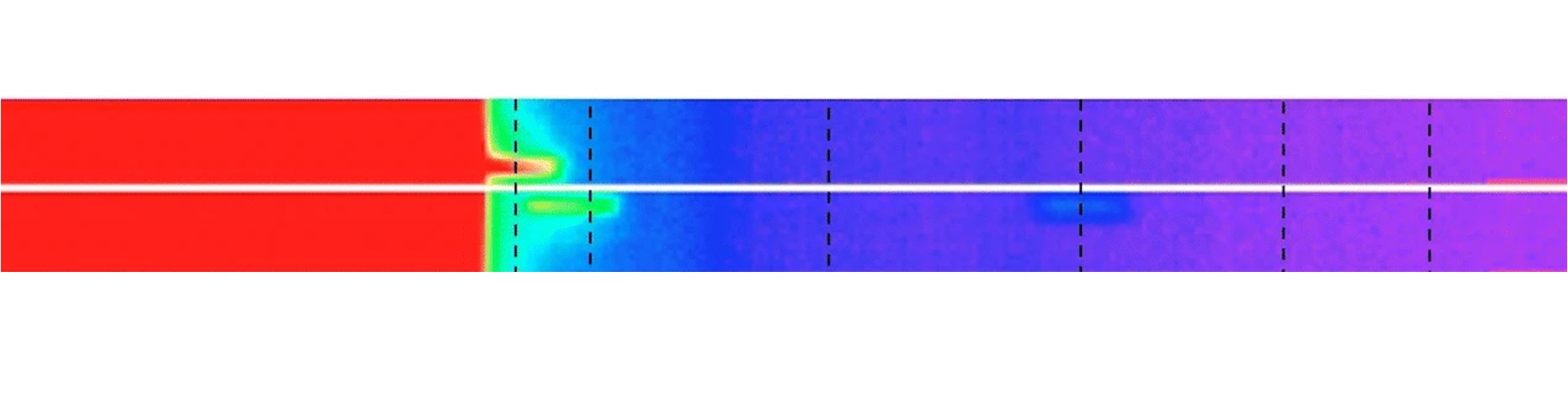
The interaction between the powder feedstock and the propellant gas plays a critical role in determining the deposition outcome in Cold Spray processes. The Cold Spray Laboratory was the first to measure the individual temperature of particles using a high-speed infrared camera operating at 24,000 frames per second. To capture particle velocity, Particle Streak Velocimetry and Particle Tracking Velocimetry techniques were employed. The infrared camera records total radiation, which includes the particle’s own emitted energy, reflected radiation from surrounding surfaces, and infrared emission from the atmosphere. From this data, the electromagnetic radiation emitted by the particle in the mid-infrared spectral range is isolated. These measurements provide valuable insights into the fundamentals of heat transfer in micrometer-sized particles traveling at supersonic speeds.
Industrial application
Electronic devices generate heat during operation, which can degrade performance and reliability. Integrated circuit (IC) components with higher thermal power consumption often require heat sinks to dissipate heat and prevent junction temperatures from exceeding their maximum allowable limits. The effectiveness of a heat sink is typically measured by its thermal resistance. Cold Spray technology is an advanced surface coating and additive manufacturing method that enables the bonding of copper to other materials. It addresses challenges associated with traditional welding and brazing techniques and helps reduce thermal resistance, improving heat transfer efficiency
Selected projects