
Research at TEE Lab
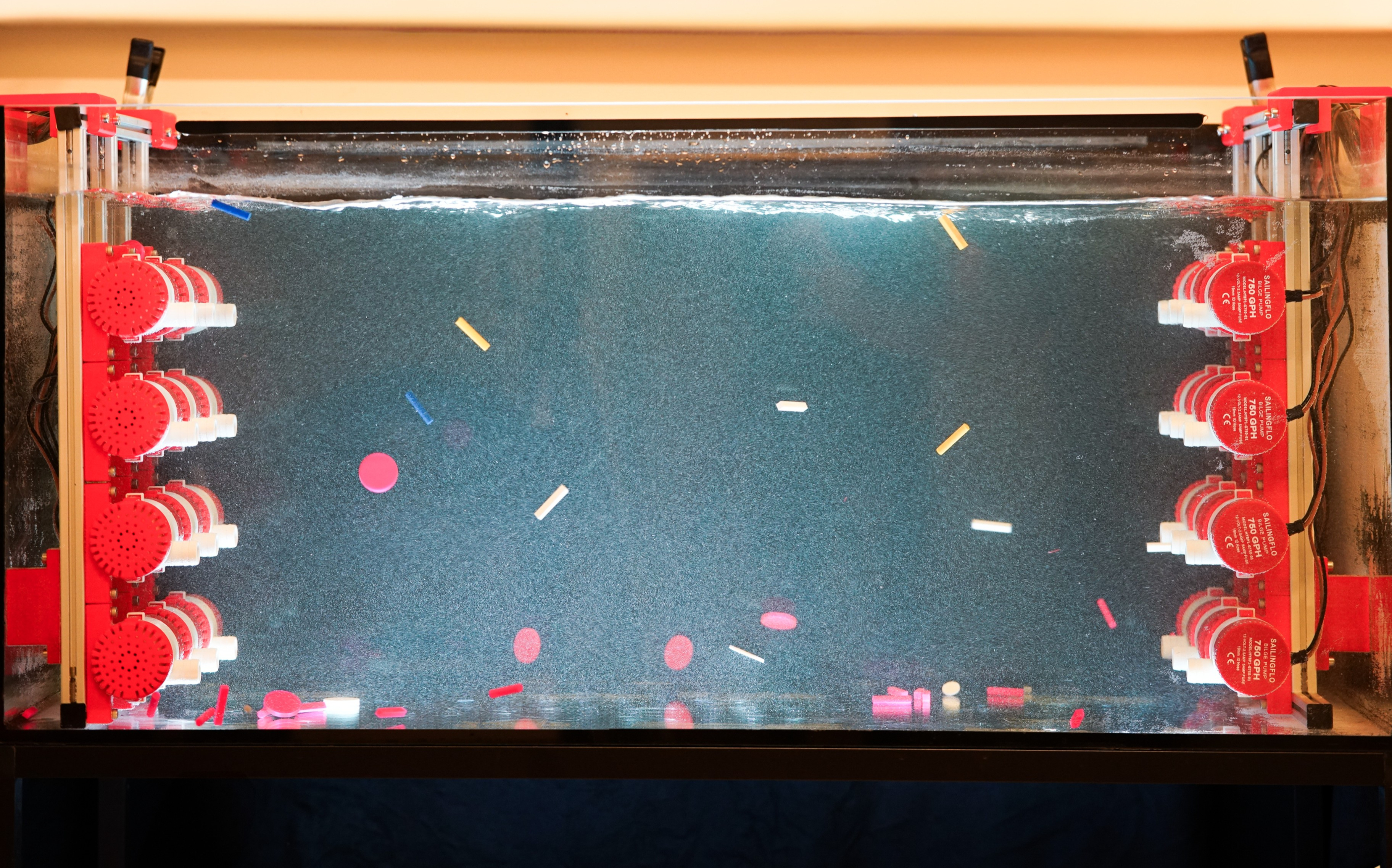
TEE Lab seeks to deepen our understanding of how turbulent motions influence the transport, dispersion, and interactions of suspended phases such as pollutant particles, microplastics, bubbles, and ice in natural and engineered systems. Motivated by environmental challenges such as marine pollution and climate‑driven changes in aquatic and atmospheric flows, we conduct carefully controlled laboratory experiments to uncover the physical mechanisms underlying turbulent environmental processes and multiphase transport. We also welcome studies across the broader spectrum of fluid dynamics, including aerodynamics, biofluid flows, and other systems governed by complex or unsteady flow behaviour.
Relating free-surface features to sub-surface turbulence
Keywords: free-surface turbulence, profilometry technique, particle image velocimetry, turbulence tank, remote sensing, dimples, scars
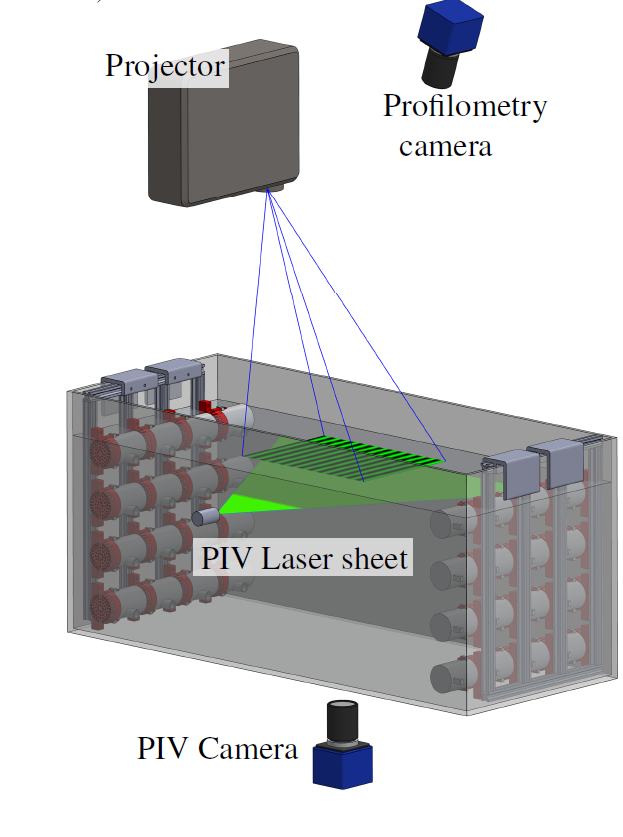
When we walk past a river, the surface reveals several visible structures that come and go with the flow. These patterns are the imprint of energetic turbulent motions beneath the surface, offering a window into otherwise hidden subsurface dynamics. This study thus examines how turbulent motions beneath a free surface are linked to visible surface features. Using simultaneous free‑surface profilometry to measure surface topology and particle‑image velocimetry to resolve subsurface velocity in a jet‑stirred turbulence tank, the work extends previous DNS results into the experimental domain.
The analysis shows that strong correlations between surface features and subsurface horizontal divergence persist at much higher Reynolds numbers and remain significant well beneath the surface‑influenced layer. These findings demonstrate that observable free‑surface patterns carry quantitative information about energetic subsurface turbulent motions, highlighting the potential of surface observations for remote sensing and monitoring of subsurface flow dynamics.
Dispersion of inertial finite-size particles
Keywords: particle-turbulence interactions, free stream turbulence, environmental flow, particle tracking
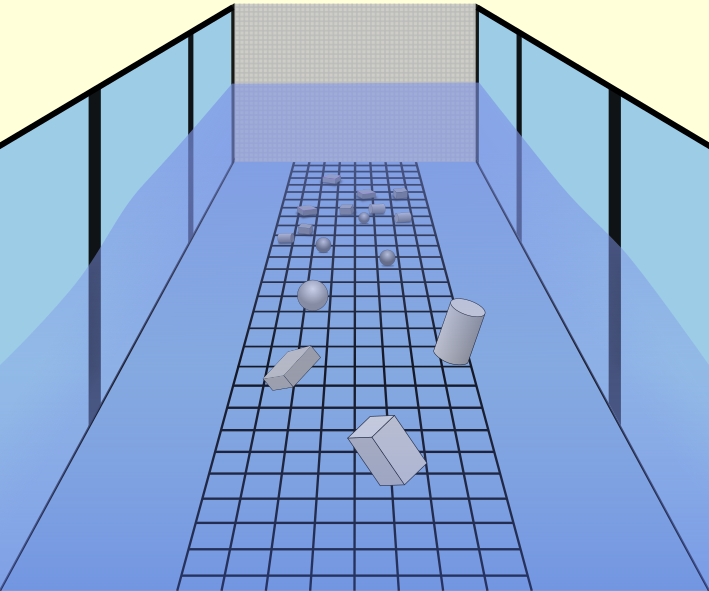
Turbulence strongly affects how particles are transported and dispersed in aquatic systems, and understanding these links is central to understanding the fate of plastic pollution. This project investigates the dispersion of negatively buoyant, finite‑size particles of different shapes (spheres, circular and square cylinders, and flat cuboids) and sizes (6 and 9 mm) in turbulent open‑channel flow, using a catch grid placed along the channel floor to record particle landing locations.
The results show that particle dispersion, quantified using the root‑mean‑square of landing positions, varies strongly with particle shape, size, settling velocity, and flow conditions, and becomes more predictable as turbulent fluctuations increase. An empirical relation is proposed linking turbulent velocity fluctuations, integral length scales, particle settling velocity, and particle size to streamwise dispersion. These findings demonstrate that finite‑size inertial particles do not disperse as simple passive tracers, and that particle geometry must be explicitly incorporated into dispersion models.
Particle-wake interactions for free falling particles
Keywords: finite particles, vortex shedding, environmental flow, volumetric reconstruction
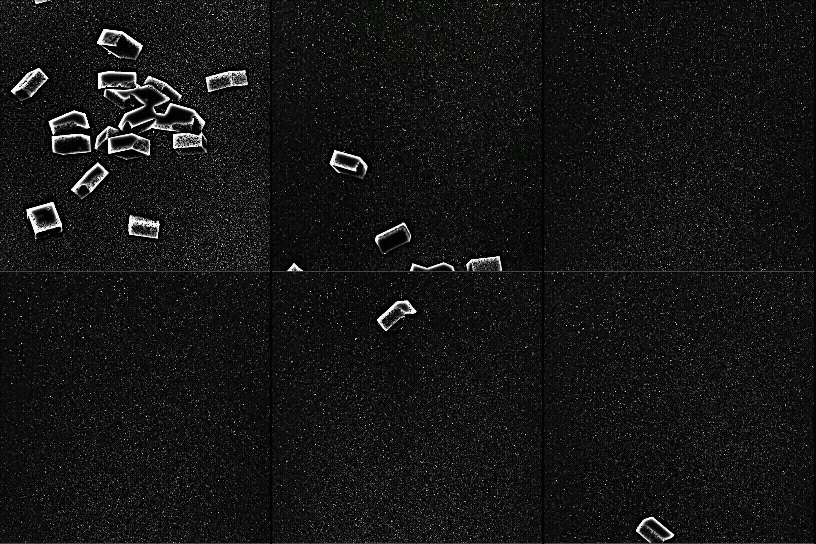
Moving beyond the classical focus on the wake dynamics of isolated particles in quiescent flow, this project investigates how wakes generated by collectively settling particles influence particle motion and wake dynamics, Using time‑resolved volumetric measurements based on the Shake‑The‑Box technique, we track both three‑dimensional particle motion and the surrounding flow fields for negatively buoyant particles of four different geometries as they settle individually and through the turbulent wakes of upstream particles.
The results show that particles settling through bulk wakes fall faster than in quiescent flow due to additional downward momentum imparted by the turbulent wake. The measurements further reveal strong wake–shear‑layer interactions upstream of the particle and a more chaotic downstream wake compared to quiescent conditions. Together, these findings demonstrate how interactions between settling particles and turbulent wakes fundamentally influence particle transport, with important implications for predicting the fate of pollutants and sediments released into natural aquatic environments in bulk.
Resolving sphere dynamics in turbulent wall-bounded flow
Keywords: particle-turbulence interactions, turbulent boundary layer, environmental flow, particle tracking, particle image velocimetry
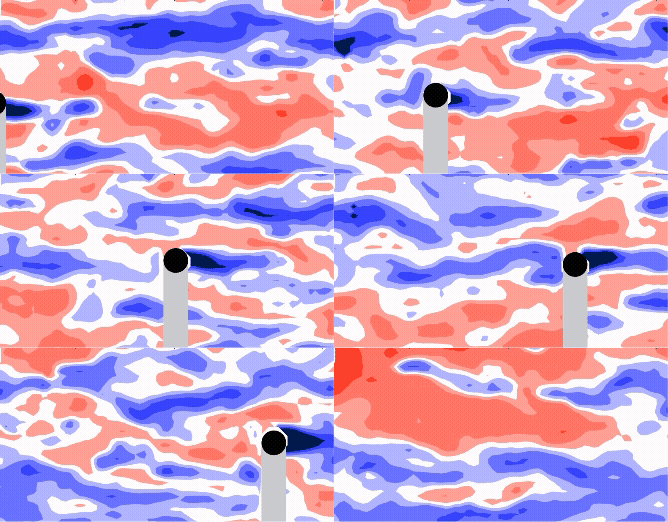
In simulations, particles are often modeled as point mass particles for simplicity and to save computing time. This research therefore studies how turbulence, particle rotation and wall interactions together affect the motion of finite size spherical particles that are released in a turbulent boundary layer, where the point mass assumption breaks down. Using three‑dimensional particle tracking and simultaneous velocity measurements in laboratory boundary layers, the studies quantify both translational and rotational motion of particles with different densities as they lift off, slide, roll, or saltate along the wall.
The results show that particle behavior is strongly influenced by large‑scale turbulent structures, wall friction, and finite‑size effects that are absent in classical point‑particle models. Less‑dense particles tend to lift off and travel above the wall with minimal rotation, while denser particles initially slide along the surface before undergoing forward rolling and repeated lift‑off events driven by Magnus lift. Simultaneous measurements reveal strong correlations between particle motion and surrounding fluid velocity, demonstrating that turbulent flow structures directly control particle acceleration, rotation, and dispersion. Together, these findings highlight the critical role of finite particle size and rotation in wall‑bounded turbulence and provide experimental benchmarks for improving predictive models of particle transport in environmental and engineering flows.