
Biological Invasions and Patchy Landscapes
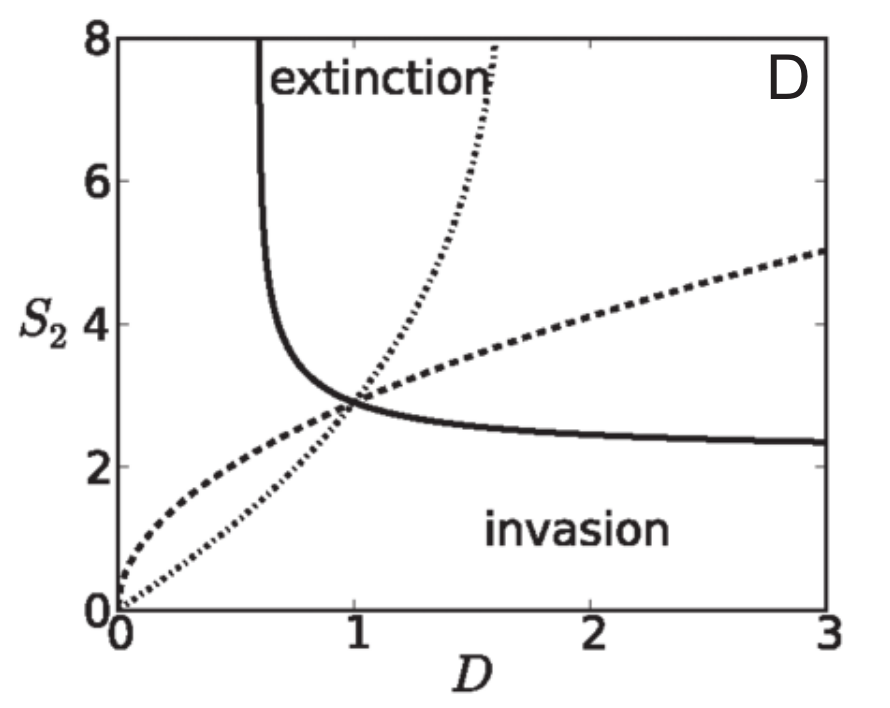
The spread of alien species into novel territory is a great threat to many existing ecosystems. Can one predict how fast such biological invasions will proceed? In particular, how fast will a new species spread in a strongly heterogeneous landscape where favourable and unfavourable patches are interspersed? How should evolution select dispersal rates in source-sink landscapes? What happens is patches move due to climate change?
Selected publications (the full list is here)
F. Hamel, F. Lutscher, M. Zhang (2022) Propagation phenomena in periodic patchy landscapes with interface conditions. Journal of Dynamics and Differential Equations 36: S435–S486
G. Maciel, C. Cosner, R.S. Cantrell, F. Lutscher (2020) Evolutionarily stable movement strategies in reaction–diffusion models with edge behavior. Journal of Mathematical Biology 80(1-2): 61–92.
G. Maciel, F. Lutscher (2018) Movement behavior determines competitive outcome and spread rates in strongly heterogeneous landscapes. Theoretical Ecology 11(3): 351–365.
G.A. Maciel, F. Lutscher (2013) How individual movement response to habitat edges affects population persistence and spatial spread. The American Naturalist 182(1): 42–52
S. Dewhirst, F. Lutscher (2009) Dispersal in heterogeneous habitats: thresholds, spatial scales, and approximate rates of spread. Ecology 90(5): 1338–1345