
Conservation Biology
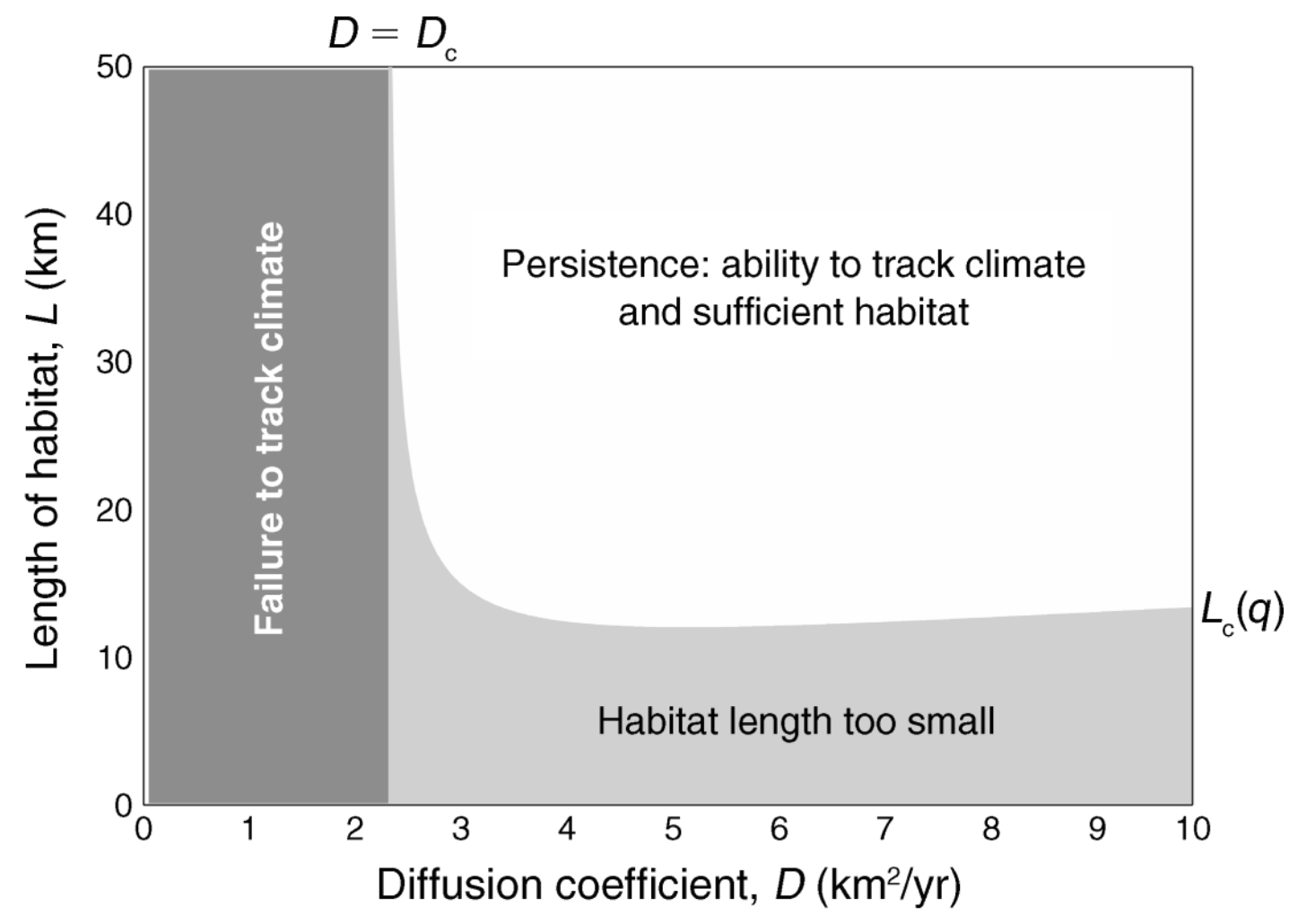
The existence of many species is threatened by loss of suitable habitat, its fragmentation, or a shift in suitable habitat due to climate change. How can we quantify the minimum habitat requirements in the face of global change? More generally, how are stationary and non-stationary distribution patterns affected by habitat loss and human intervention? How can we measure and predict the effect of human intervention?
Selected publications (the full list is here)
J. MacDonald, F. Lutscher, Y. Bourgault (2024) Climate change fluctuations can
increase population abundance and range size. Ecology Letters 27(6), e14453
S.M.J. Portalier, J.N. Candeau, F. Lutscher (2024) Climate Change affects the outbreak frequency of a boreal forest defoliator through phenological mismatch. Ecological Modelling 493, 110724
S.M.J. Portalier, J.N. Candeau, F. Lutscher (2022) A temperature-driven model of phenological mismatch provides insights into the potential impacts of climate change on consumer-resource interactions. Ecography 8: e06259
E. Crone, L. Brown, J. Hodgson, F. Lutscher, C. Schultz (2019) Faster movement in habitat matrix promotes faster range shifts in heterogeneous landscapes. Ecology 100(7): e02701
S.J. Leroux, M. Larrivee, V. Boucher-Lalonde, A. Hurford, J. Zuloaga, J.T. Kerr, F. Lutscher (2013) Mechanistic models for the spatial spread of species under climate change. Ecological Applications 23: 815-828
W.F. Fagan, F. Lutscher (2006) Average dispersal success: linking home range, dispersal, and metapopulation dynamics to reserve design. Ecological Applications 16(2): 820-828