

Next-generation thermal barrier coatings
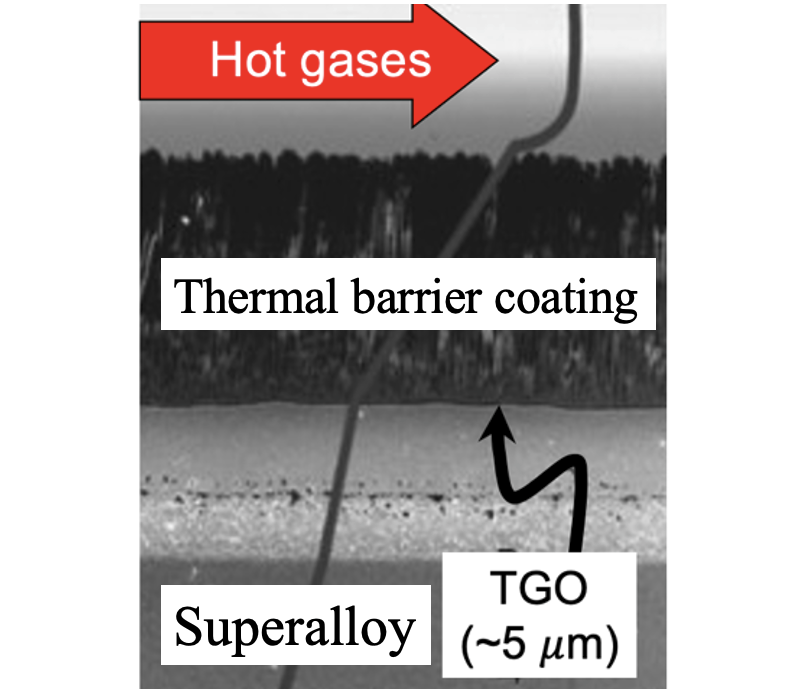
Thermal barrier coatings
The consistent demand for improving the efficiency and power output of power plants, land-based power generators and aircraft engines requires maximizing the operating temperatures. An adverse consequence of such extreme operating conditions in gas turbine engines is that operation temperatures approach and sometimes even exceed the allowable material limits (i.e. melting temperature of superalloys). This necessitates thermal barrier coatings for protecting hot-section components. The state-of-art thermal barrier coating material is yttria-stabilized zirconia (YSZ), which has a thermal conductivity of 1 W/mK. This value ultimately limits the efficiency of high-temperature engineering cycles to be around 30%, as a substantial amount of thermal energy goes towards detrimental solid-state chemical reactions or escapes the system as waste heat.
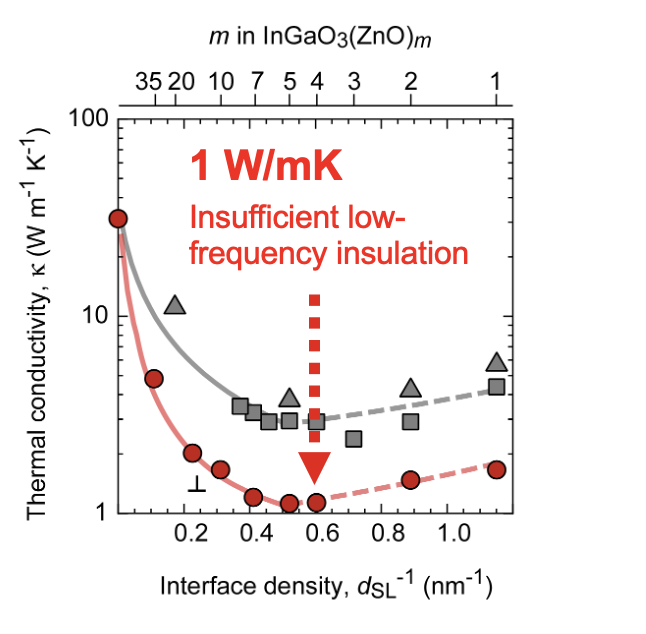
Limitations with state-of-art thermal barrier coatings
Because of the need for thermal stability at high temperatures, the choice of insulating materials is largely restricted to ceramics and oxides, where heat is primarily carried by atomic vibrational waves—called phonons. The standard approach to lowering thermal conductivity in these materials is by promoting phonon scattering, a process where phonons lose momentum and change direction upon encountering obstacles such as crystal defects, grain boundaries, or impurities. Upon adding these obstacles with doping or grain boundary engineering, heat flow is disrupted, and the thermal conductivity is reduced. Using this approach, the lowest thermal conductivities achieved in state-of-the-art dense ceramics and oxides are around 1 W/m·K, as shown in the Figure on the left. The origin of this lower bound threshold is low-frequency phonons, which exhibit long wavelengths as pass through crystal defects. Therefore, to achieve thermal conductivity below 1 W/mK, a new design principle capable of handling low-frequency phonons is needed.
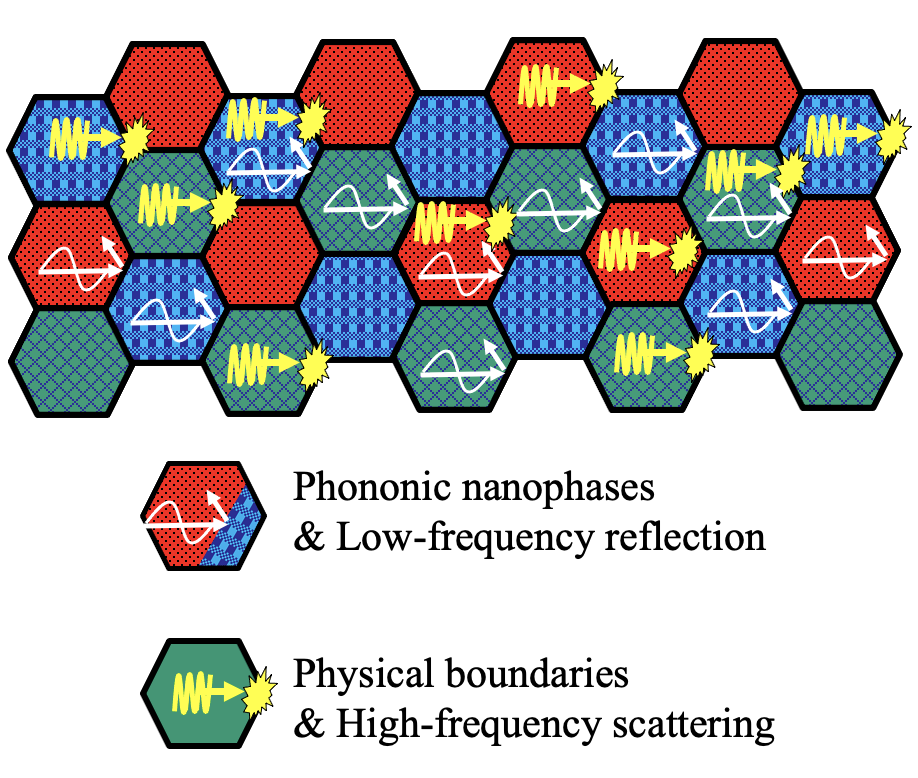
Phononic materials for solution
Nanostructures with periodically arranged crystal defects can impose boundary conditions that induce destructive interference for long-wavelength (low frequencies) phonons according to the acoustic mismatch between the periodic constituents, effectively eliminating specific phonon frequencies and creating phononic band gaps in the vibrational density of states of the structure. Dr. Cho has demonstrated that such nanostructures can reflect phonons with frequencies below 1 THz, confirming that this phenomenon can disrupt low-frequency phonon propagation [Cho et al., J. Phys. Soc. Jpn., vol. 91(1) 014601, 2022]. This introduces a powerful new mechanism—phonon reflection via phononic band gaps—to complement traditional phonon scattering methods that primarily target high-frequency phonons. By integrating these two approaches, the team aims to design multi-phononic nanostructured materials capable of simultaneously suppressing both low- and high-frequency phonon transport. In these materials, high-frequency phonons will be scattered by conventional grain boundaries and defects, while low-frequency phonons will be reflected due to multiple mismatches in phononic band structures (Left). This dual mechanism has the potential to reduce thermal conductivity by an order-of-magnitude over current materials—without sacrificing mechanical robustness. This breakthrough approach offers a pathway for next-generation thermal insulation technologies in energy and aerospace applications.
Impact of this research
Upon success, this project will lead to thermal barrier coatings with thermal conductivity ~0.1 W/mK. This represents a 10-fold increase in the heat insulation capacity compared to the state-of-art YSZ (1 W/mK). Examples of immediate engineering impacts are listed below.
1 - The increase in the heat insulating capacity will allow much higher turbine inlet temperature, which will significantly increase the efficiency. For reference, 170 degree increase in the turbine inlet temperature increases the efficiency from 30% to 60% [U.S. Department of Energy, "How gas turbine power plants work"].
2 - The new phononic thermal barrier coatings will offer a 10-fold increase in the temperature drop across the thermal barrier coating. This means the base superalloy for aerospace components can be replaced with carbon-fiber composites, which will significantly reduce the weight.
3 - Thermal degradation will be exponentially suppressed compared to the state-of-art YSZ, as chemical reaction is an exponential function of temperature. This will significantly reduce the maintenance cost of high-temperature engineering systems.
*This project is funded by Canada Foundation for Innovation and Natural Sciences and Engineering Research Council of Canada