
In Vitro / In Vivo Assessment of Cryo-efficacy
The need for improved cryopreservation procedures resulting in increased cell viability post-thaw is urgently required as the field of regenerative medicine continues to rapidly develop. Unfortunately, current cryopreservation protocols are less than ideal and furnish low cell yields and poor functionality after cryopreservation. This is significant since recent studies have linked the successful outcome of regenerative therapies with the proportion of viable cells prior to transplant. Dimethyl sulfoxide (DMSO) is currently regarded as the “gold standard” for cryopreservation. While all cryoprotectants are potentially cytotoxic in vitro, DMSO has exhibited significant cytotoxic effects in the clinical setting. Inhibiting the uncontrolled growth of ice is critical for a successful cryopreservation outcome. Current strategies and protocols fail to control ice growth thus poor post-thaw viabilities, recoveries and post-thaw function are often observed.
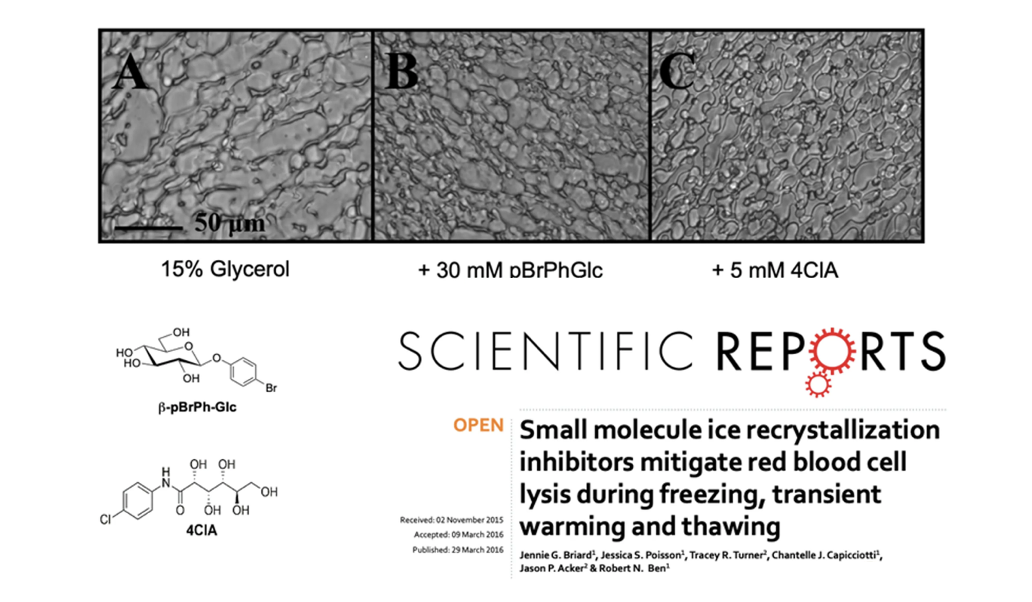
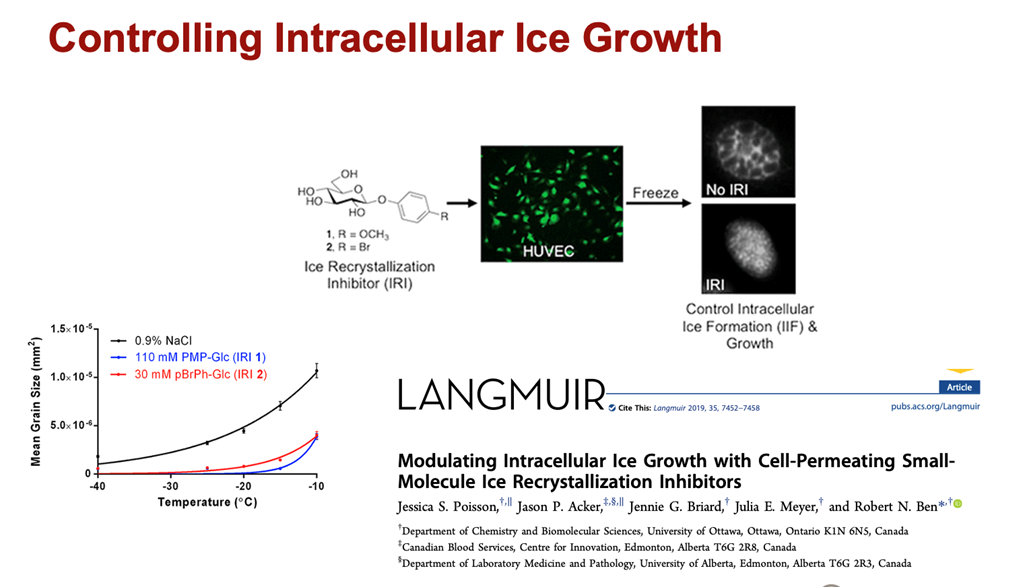
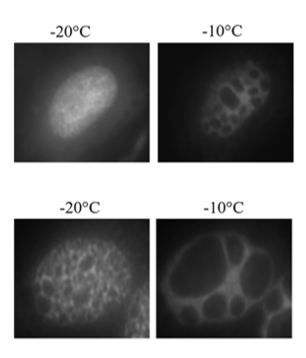
Our laboratory has recently elucidated a positive correlation between carbohydrate structure/hydration and the ability to inhibit ice recrystallization. This work has enabled us to further demonstrate that inhibition of ice recrystallization during cryopreservation dramatically increases cell viability/functionality post-thaw. In the first comprehensive study of its kind, we correlated ice recrystallization-inhibition (IRI) activity of various mono- and disaccharides to cytotoxicity and cell viability after cryopreservation at -180 oC for five days. Many variables were examined including different cell lines, cell medium, carbohydrate concentration, structure and cytotoxicity of the carbohydrate. These results validate our hypothesis that the ability to inhibit ice recrystallization should be an essential property of all cryoprotectants. Ironically, most cryoprotectants (DMSO included) do not exhibit this activity. This work has been extended to demonstrate the benefits of inhibiting ice recrystallization in human umbilical cord blood. Furthermore, we have studied the in vitro interactions of our C-AFGPs, determined that they function as cell-penetrating cryoprotectants and assessed their ability to cryopreserve human liver cells.
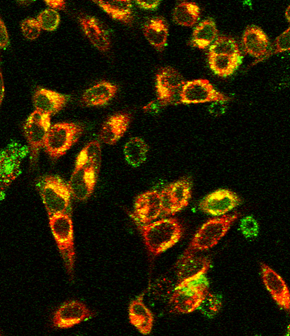
In these experiments, the C-AFGP is as effective as a 2.5% DMSO solution and doubles the number of viable cells post-thaw relative to the control group. Subsequently, the potential of C-AFGPs (and small molecule inhibitors of ice recrystallization) have attracted industry attention with their potential and we are working with the Canadian Blood Services to improve the cryopreservation of red blood cells and with Insception BioSciences (the largest private blood banking company in Canada) to improve the cryopreservation of human umbilical cord blood and its hematopoietic stems cells.
Featured Publications
Wu, L. K.; Al-Hejazi, A.; Filion, L.; Ben, R. N.; Halpenny, M.; Yang, L.; Giulivi, A.; Allan, D. S. Increased Apoptosis in Cryopreserved Autologous Hematopioetic Progenitor Cells Collected by Apheresis and Delayed Neutrophil Recovery after Transplanation: A Nested Case-controlled Study. Cytotherapy 2012, 14, 205.
Czechura, P.; Tam, R. Y.; Dimitrijevic, E. ; Murphy, A. V. ; Ben, R. N. The Importance of Hydration for Inhibiting Ice Recrystallization with C-Linked Antifreeze Glycoproteins. J. Am. Chem. Soc. 2008, 130, 2928. (ACS Highlight article and Faculty of 1000 Biology Editorial highlight)
Chaytor, J. L.; Tokarew, J.; von Moos, E.; Goulla, L.; Findlay, S.; Wu, L.; Allan, D.; Ben, R. N. Inhibiting Ice Recrystallization and Optimization of Cell Viability after Cryopreservation. Glycobiology 2011, 22, 123.
Wu, L.; Tokarew, J.; Chaytor, J. L.; vonMoos, E.; Li, Y.; Palii, C.; Ben, R. N.; Allan, D. Carbohydrate Mediated Inhibition of Recrystallization in Cryopreserved Human Umbilical Cord Blood. Carbohydr. Res. 2010, 246, 86.
Leclere, M.; Kwok, B.; Wu, L. K.; Allan, D. S.; Ben, R. N. C-Linked AFGP Analogues as Novel Cryoprotectants. Bioconjugate Chem. 2011, 22, 1804.